Let me tell you the story about a folk hero who ran the entire length of Cuba.
He lived an unusual life and by the end of this video you can decide for yourself whether this is a tragic tale or a story of ultimate triumph.
His name was Félix de la Caridad Carvajal y Soto, affectionately dubbed “El Andarín” (The Walker), a Cuban long-distance runner, mailman, and the protagonist of the strangest Olympic marathon in history.

Carvajal was born on March 18, 1875, in San Antonio de los Baños-a small town located about 26 kilometers outside Havana. As a child, he was described as a “wiry little guy” who could easily outrun everyone else and continue even after the rest had quit.
Foreshadowing? I think so.
The St. Louis Riverfront Times noted that he stood just an inch or two over five feet tall with a slender, scrawny frame. But biologically? He was built for endurance. According to modern sports science, the ideal long-distance runner has a slender frame and low body mass. Carvajal weighed in at 47 kg, making him scientifically optimized for long-distance running.
Carvajal put his endurance to use early in his youth, working as a military courier during the Cuban War of Independence and the Spanish-American War. He delivered critical dispatches across the rugged Cuban countryside, often covering 30 miles or more in a single day on foot. This was because horses were scarce and a man on a horse was a very easy target for the enemy.
Legend has it that he ran the entire 700 mile (1126 km) length of Cuba to deliver vital war dispatches.
But like with many legendary figures, there are conflicting versions of this story.
The truth is likely a blend of a few stories.
It is a well-known fact that his war routes were grueling; however, the most verifiable account reveals that he ran the length of Cuba only later in his life at age 55. He ran from Santiago de Cuba to Havana to prove he still had stamina.
Which account is true? Quite possibly all of them. It is entirely plausible that he completed such cross-island treks more than once throughout his lifetime. Beyond the sheer physical achievement, Carvajal became a folk hero representing resilience and endurance during a challenging era in Cuban history.
However, his real claim to fame wasn’t being a military courier. It was his journey to the 1904 St Louis Olympics.
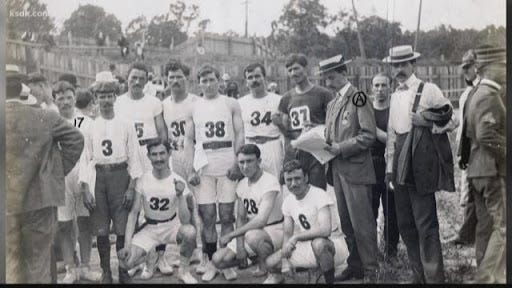
Carvajal wanted to be an Olympian. The problem he faced was that Cuba had no official Olympic committee to fund him, and he certainly didn’t have the personal funds for a steamer ticket to Missouri. So, he took matters into his own hands. Utilizing his natural talent, he put on running demonstrations in Havana’s Parque Central to crowd-fund his travel expenses. It has been reported that he stood on a soapbox, loudly declared that he was the greatest runner alive, and proved it by running endless laps around the plaza until a massive crowd gathered. He would then pass around his mailman’s hat to collect donations.
The public was so amused and inspired by this spectacle that Carvajal raised enough money to embark on his journey to America.
Upon landing in New Orleans a few days before the race, disaster struck and set the tone for the entire experience. Carvajal lost all his money in a dice game. Penniless, stranded, and speaking very little English, he was forced to hitchhike, walk, and run over 700 miles to St. Louis. He survived on the generosity of strangers and whatever fruit he could forage along the road, sleeping in barns and orchards along the way.
He arrived in St. Louis on the morning of the race exhausted, hungry, and lacking proper athletic gear. Temperatures hovered around 33°C (90°F) with stifling midwestern humidity. As The St. Louis Riverfront Times noted, he arrived wearing his street shoes, knee-high stockings, a beret, a long-sleeved shirt, and heavy street trousers from his mail carrier uniform.
Just before the race began, a fellow Olympian took pity on him, found a pair of scissors, and cut off the legs of his trousers to make a pair of makeshift athletic shorts.
And with that, he lined up for the starting gun.
The 1904 Olympic Marathon was notoriously brutal and a logistical nightmare. The 40 km (24-mile) course featured steep hills and thick dust clouds created by accompanying motorcars, such as the referees’ and medical staff’s cars, which were directly behind the runners. In 1904, these early cars kicked up blinding, choking clouds of thick dust that coated the athletes’ lungs and caused severe respiratory distress. Furthermore, the chief organizer, James Sullivan, wanted to test the limit of human endurance and intentionally provided only one water station for the entire 40 km (24-mile) race, located at the 20 km (12-mile) mark. Early 20th-century science incorrectly believed that dehydration was beneficial for athletes.
Then the race descended into more chaos.
The initial winner, Fred Lorz, suffered severe cramping at around mile 9. He then proceeded to hitch a ride in a car for 11 miles, after which he hopped back out to jog across the finish line.
Len Taunyane was a South African and Zulu tribesman who was running the race barefoot. During the race, he was chased off course by a pack of aggressive wild dogs, ruining his time.
Thomas Hicks, the eventual official winner, was hallucinating wildly from exhaustion. His trainers kept him going by feeding him a mixture of raw eggs and strychnine sulfate-literally rat poison-which was used as a legal stimulant at the time. He had to be physically carried across the finish line by his handlers.
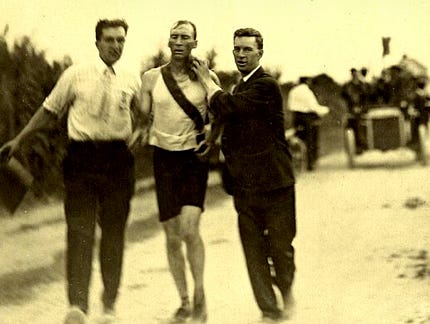
Where was Carvajal during all this madness?
He was actually making incredible time, keeping pace with the leaders. But he hadn’t eaten a proper meal for days. Feeling hungry mid-race, he stopped at an orchard along the route and ate several rotten apples, which gave him severe stomach cramps. Despite having to lie on the side of the road to recover, he pushed through to finish in fourth place. In fact, he was so delirious at that point that he tried to keep running for another lap before officials physically stopped him.
Overwhelmed by emotion, he wept after the race, disappointed not to have won after such a long and difficult journey.
Following the Olympics, Carvajal remained in St. Louis for a period of time, joining the Missouri Athletic Club and competing in local distance events before eventually returning to Cuba.
Lope Magazine reported that Carvajal had been racing since childhood, famously winning an all-day endurance run at age 14 by running continuously from 8 a.m. to 7 p.m. His colorful personality, stamina, and determination cemented his legacy as one of distance running’s most iconic figures.
The tale of his later life becomes murky, with rumors of him running exhibitions well into his old age. But the point is, there was a fire in this man that could not be ignored. He charged at life like he had nothing to lose and everything to gain at the finish line. And this was a man who lived in poverty his entire life.
If Félix Carvajal can survive the most disastrous sporting event in history in a pair of chopped-up army pants, then there’s nothing stopping us from walking to the moon.